Tag: vision loss

Why Do My Eyes Need to be Dilated?

Why Do My Eyes Need to be Dilated?


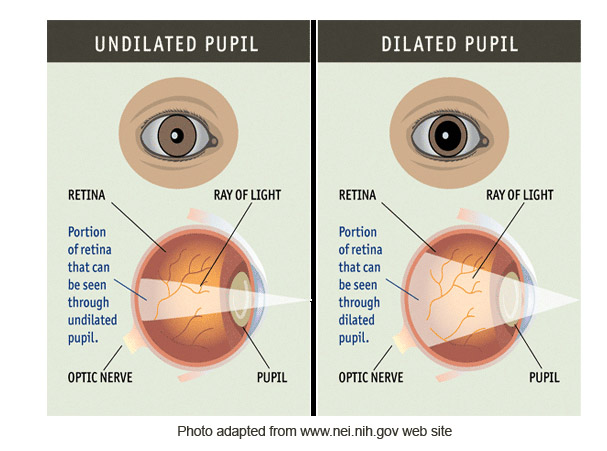
This is a common question that we hear from patients.  A simple explanation will explain the importance and reason this process is performed as part of a comprehensive eye health exam.  The inside of eye is lined with a delicate tissue called the retina.  The retina is a crucial component of the eye which allows light to be interpreted for central and peripheral vision.  In order to evaluate the retinal health, we have to look through the pupil, which is the dark spot or opening in the center of the eye.  Pupil sizes vary depending on a variety of factors. For example, two of the most common factors affecting pupil size are age (as age increases, pupil size decreases) and medications.


When light is shined in the eye, the iris, or colored part of the eye constricts, which decreases the pupil size. If one thinks of the pupil as the aperture of a camera, then the smaller the pupil (or aperture) the more limited the hole your eye doctor can look through. This translates to a smaller amount of retina we can evaluate.  Typically, we can evaluate about 40% of this tissue without dilation, depending on the natural pupil size of that individual.  Dilation is necessary to assess the peripheral retina for tears, thinning, holes, or other lesions that could potentially lead to vision loss.  


Once performed and the retina is determined to be healthy, dilation may not need to be repeated every year.  However, certain symptoms may develop which necessitate dilating the eyes in an urgent manner such as flashes of light, new floaters, or peripheral vision loss.  Diabetics should be dilated every year.


Different strength dilation medications and side effects are dependent on the size of the pupil and color of iris.  The side effects of dilation are: reduced focusing ability at near, and light sensitivity that typically lasts about 3-4 hours.


Our goal as your eye care provider is to ensure healthy eyes, lifelong.  Performing dilation allows for completion of your comprehensive exam at the time of your annual visit.  Indications and contraindications for dilation are determined on an individual patient basis.  
Related image

World Sight Day 2015 awareness

World Sight Day Awareness

4 out of 5 blind people are needlessly so. Many times blindness is avoidable with proper care, protection, or early detection of issues.

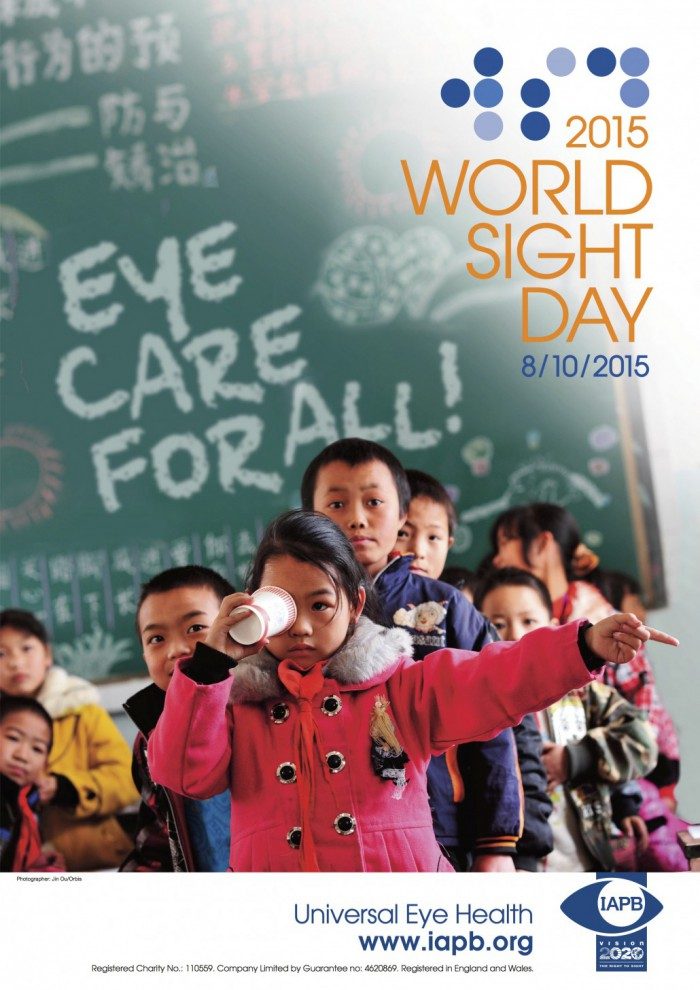
Today, Thursday October 8th is officially World Sight Day (WSD). It’s not necessarily meant to be a global day of celebrating sight, it’s more about how not everyone is fortunate enough to have sight or to even have the opportunity to correct vision impairment. Per the International Agency for the Prevention of Blindness (IAPB), “World Sight Day is an annual day of awareness held on the second Thursday of October, to focus global attention on blindness and vision impairment.”

2015 is the third year the WHO Global Action Plan and IAPB encourages their members and partners to continue with the theme of “Universal Eye Health.” This year, the “Call to Action” for World Sight Day is “eye care for all.” Everyone deserves the access to preventative eye care and the chance to have their vision corrected!

The key messages for WSD awareness from IAPB are as follows:

  • Approximately 285 million people worldwide live with low vision and blindness
  • Of these, 39 million people are blind and 246 million have moderate or severe visual impairment
  • 90% of blind people live in low-income countries
  • Yet 80% of visual impairment is avoidable – i.e. readily treatable and/or preventable
  • Restorations of sight, and blindness prevention strategies are among the most cost-effective interventions in health care
  • The number of people blind from infectious causes has greatly reduced in the past 20 years
  • An estimated 19 million children are visually impaired
  • About 65 % of all people who are visually impaired are aged 50 and older, while this age group comprises only 20% of the world’s population
  • Increasing elderly populations in many countries mean that more people will be at risk of age-related visual impairment.

IAPB is sponsoring an #EyeCareForAll Photography competition this year. Read more about entering the competition and the great prizes.

eye disease macular degeneration

Age-Related Macular Degeneration Awareness Week

Our eyes matter. It’s the truth and it’s also the theme of AMD Awareness Week. AMD stands for Age-related Macular Degeneration. Here are the facts about AMD.

Age-related Macular Degeneration is an eye disease that is the leading loss of vision for people age 50 and older. Now it doesn’t necessarily cause complete blindness since it affects the macula in the center of your eye. The macula is a small spot near the center of your retina. This is where you have the sharpest vision. AMD can cause a blind spot or blurriness which can affect your ability to see, read, perform tasks, or drive.

Age-related Macular Degeneration is more likely to occur after 60 years of age. Other factors are smoking, race, high blood pressure, high cholesterol, obesity, poor diet and high sun exposure. Smoking has been shown to double the risk of AMG. Caucasians have a higher incidence of AMD. It is genetic so if your family has a history of AMD, you should have regular comprehensive eye exams.

AMD can be diagnosed by regular eye exams. Early diagnosis can help prevent or reduce loss of vision. The early stages of AMD may have little to no symptoms so it’s important to see your eye doctor. Symptoms may not occur until later stages of the disease or becomes noticeable when vision in one or both eyes are affected.

For more information about age-related macular degeneration and info about treatment, visit the National Eye Insitute. 

The Important Thing About Change…and your vision.

Love-change-SmallIf there is one thing in life that we can always count on it is the experience of change we’re all liable to visit at one time or another. Life is all about change. And, depending on your disposition, experience and belief system, you’ll either experience change with some degree of apprehension or pure delight. Either way, we all agree, change will happen.
Take it from us! Change is inevitable. We feel akin to experts in this matter. Have you noticed our recent location change, team dynamics change, and even our “look” has changed? Exactly. We’re pros at this…or not.
Nevertheless, the question remains: “What is the best way to navigate one of life’s more challenging changes we may all experience at some point or another? What is that change you may ask? How about the change in our vision. This can be a very scary experience for some and for  others, it can go unnoticed resulting in new experiences we would rather not have.
To help you navigate an otherwise intimidating landscape, here are a few tips to keep you balanced, clear and happy — if and when a change in vision becomes your experience.
SIGNS YOUR VISION MIGHT HAVE CHANGED:
  1. Losing Focus:  The most common age-related vision change — presbyopia — happens to almost everyone beginning between the ages of 40 and 50. A natural result of aging, the lens begins to lose elasticity, making it harder to focus vision up close for such activities as reading. But presbyopia can be corrected easily with reading glasses or glasses with bifocal, trifocal or progressive (“no-line”) lenses.
  2. Declining Sensitivity:  The lens of the eye also becomes increasingly dense and more yellow with age. These changes may affect color perception and contrast sensitivity. For instance, the color blue may appear darker and harder to distinguish from black. And it may become difficult to tell where an object ends and its background begins, making it difficult to see curbs or steps, for example.
  3. Needing More Light:  As the eye ages, the pupil gets smaller, resulting in the need for more light to see well, along with more time to adjust to changing levels of illumination (going from daylight into a dark theater or dimly lit restaurant, for example).
The good news is if you experience any of the following symptoms rest assured it’s normal.  The most important thing to remember is a change in vision does not mean nor does it indicate an end result of a loss of sight. A great way of intentionally working towards keeping your sight and promoting optimal eye health is:
  1. Schedule And Keep Routine Eye Appointments. Just like most of our healthcare concerns, our precious sense of sight is equally as important as visiting our family doctor, dentist or OB GYN.
  2. Exercise Daily and Monitor Blood Pressure. For many of us a daily routine or even weekly habit for exercise does the body good. One early sign of vision change is our blood pressure and a great way of maintaining optimal health is to exercise regularly.
  3. Guard Your Eyes From The Sun. Yes, believe it or not, it’s normally not a good idea to gaze directly at the sun and given the effects of UV rays, our eyes are sensitive creatures and require our attention to detail. That detail can be as simple as grabbing those shades on the way out the door.
  4. Protect  Your Eyes. In the event of any injury, whether you deem it big or not, be sure to wear protective eye gear when you are at higher risk for eye injury. So, if you’re an active sports player or you’ve experienced a cornea scratch or abrasion, protect your eyes from further injury. It’s always better to be safe, than sorry.
  5. Consult Your Doctor When Taking Supplements. As healthy as we all want to be, we also want to be smart. When taking supplements, be sure to consult your family doctor and to know of any and all side-effects that may occur to your body system
In the end, no matter the change, it’s important we exercise caution, wisdom and care when protecting our vision. And remember, when in doubt, consult your Optometrist or Ophthalmologist!

Industries for the Blind

It is my pleasure to share with you the extraordinary experience of my recent visit to Industries for the Blind (IFB), a local business operating in West Asheville. In our world of environmental calamities, economic uncertainty, violence and apathy, it's important to focus on something that is truly positive, something that brings a breath of fresh air to the media's consistent barrage of negative messages.

Started in 1939 in Winston-Salem and affiliated with the National Industries for the Blind, the mission of this Nonprofit 501(c) 3 is: "We will improve the quality of life for people who are blind or visually impaired by offering them employment opportunities and benefits that, without us, almost certainly would not exist". They later expanded to open branches in Asheville in 1996 and in Puerto Rico in 2006. The main function of IFB is to produce goods for the US Government. It breaks down like this…

Continue reading